
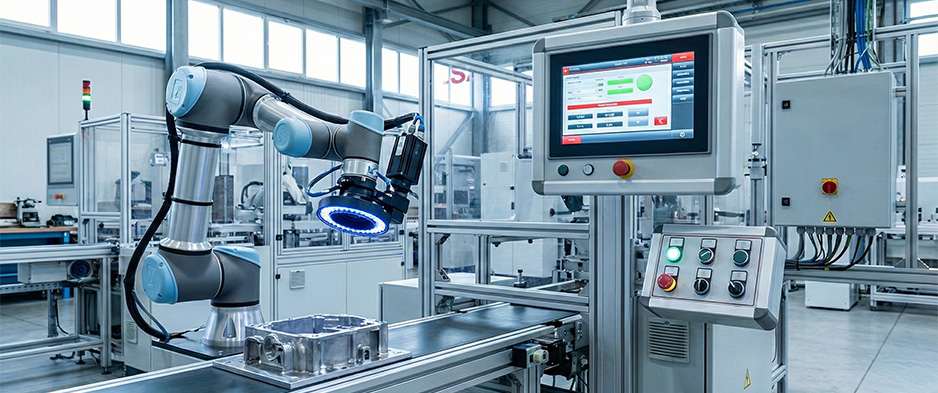
Within the Industry 5.0 framework, artificial intelligence is becoming increasingly hands-on. It is no longer limited to data analysis or decision support: AI is now embedded directly into production processes. Machine vision systems inspect quality in real time, robots adjust to part variability, and smart platforms can detect early signs of instability or unplanned downtime. This is where the concept of Physical AI comes into play, operating inside the physical reality of the factory.
AI as Part of the Production Process
Traditional automation relies on predefined sequences and fixed logic. It performs well in stable conditions, but it becomes less effective when production grows more complex, product variants increase, and unexpected situations occur more often. Today’s manufacturing environment demands flexibility that rigid automation alone cannot always provide.
Physical AI adds a new dimension. Intelligence is no longer confined to software layers or management systems: it is distributed across the shop floor, built into sensors, cameras, control systems, and robots. By combining real-time perception with learning-based models, machines can interpret what is happening on the line and adjust their actions accordingly. A practical example is machine vision in quality inspection. Modern systems do far more than check whether a component is present. They can identify subtle surface defects, assembly inconsistencies, and anomalies that depend on the production context. In industries such as packaging, electronics, and automotive, this kind of inspection is becoming essential to reduce waste and rework.
Industrial robotics is moving in the same direction. AI-guided robots supported by vision systems can operate in less structured environments, handle parts that are not perfectly positioned, correct trajectories, and adapt to changing conditions. It marks an important step toward automation that is more flexible and less dependent on perfect repeatability.
Industrial Applications and Integration Challenges
The growing interest in Physical AI is closely tied to its operational impact. Predictive maintenance is one of the most relevant areas. Thanks to data collected through sensors and monitoring systems, intelligent models can detect early signs of wear or instability, anticipate failures, and reduce unplanned stoppages. In complex plants, even small improvements in uptime can translate into significant benefits.
Flexibility is another key driver. Companies increasingly face fragmented production, smaller batches, and rising demand for customization. In this context, the rigidity of traditional automation can become a constraint. AI-enabled systems integrated into machines make it possible to adjust parameters and processes more quickly, without extensive reprogramming.
Human–machine collaboration also remains central. Collaborative robots and intelligent systems are not designed to replace operators, but to redistribute tasks: repetitive or physically demanding activities can be handled by machines, while people focus on supervision, control, and exception management.
Of course, integrating Physical AI requires careful planning. Solid architectures are needed, along with distributed computing between edge and cloud, industrial cybersecurity, and compatibility with existing equipment. Investment in skills is equally important, as these solutions depend on close coordination between operational technology (OT) and information technology (IT). In this sense, Physical AI is emerging as a practical way to improve quality, productivity, and resilience directly on the factory floor.