
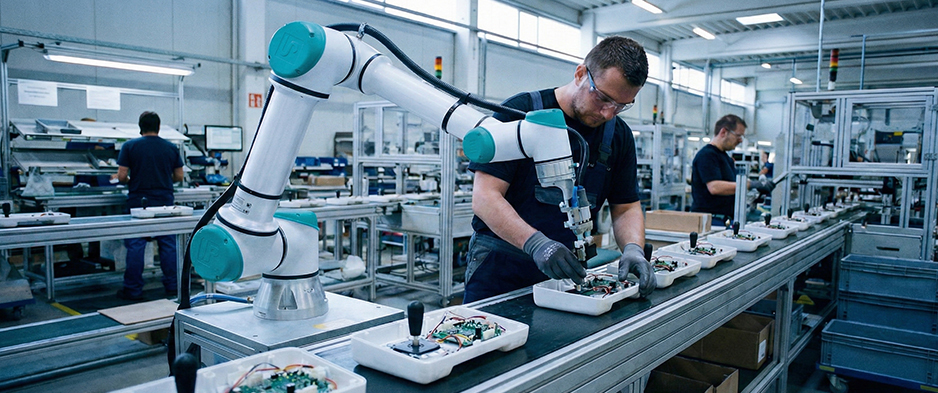
Industrial robotics in 2026 is not just an automation lever, but a true driver of operational intelligence. Robots are increasingly able to anticipate what is coming, collaborate with people and adapt to production environments in real time. Powered by AI, advanced sensing and deep digital integration, this evolution is reshaping how manufacturing processes are designed and how factories operate.
Industrial Robotics in 2026: AI at the core of machine evolution
One of the defining trends in industrial robotics in 2026 is the growing intelligence of robots, particularly their ability to interpret the environment and anticipate events. Thanks to the expanding adoption of artificial intelligence algorithms, robots are moving beyond the limits of rigid programming. They no longer simply execute predefined instruction sets. Instead, they analyse data, recognize variable objects and make operational decisions autonomously.
Machine vision plays a central role in this transformation. Camera systems and advanced sensors enable robots to identify objects, perform in-line quality inspections and handle components that are not perfectly positioned. This makes it possible to automate tasks that previously required manual intervention, even in high-variability scenarios such as logistics and assembly.
Another key development is predictive robotics. Continuous analysis of operational data allows robots to monitor their own condition, detect early signs of wear or anomalies and anticipate potential failures. Maintenance activities can therefore be planned before unplanned downtime occurs. The result is higher equipment availability and lower operating costs. Robots increasingly support operational decision-making and contribute directly to process optimization across the factory.
Collaborative and Autonomous Robots: New Models of Human–Machine Interaction
Collaboration represents another major shift in industrial robotics in 2026. Cobots are becoming faster, more accurate and more versatile, moving beyond the traditional separation between human labor and automation. The key factor is the ability to work safely and efficiently alongside operators. In this context, ease of use is critical. Intuitive interfaces, simplified programming and guided learning systems make robotics accessible even to non-specialized personnel. Robots become flexible tools that can be reconfigured quickly and deployed to support skilled operators in higher-value activities.
At the same time, autonomous mobile robots continue to expand their presence, particularly in intralogistics and material flow management. Equipped with advanced sensors and intelligent navigation systems, these robots operate in dynamic environments and interact with people and machines without relying on complex infrastructure.
Industrial robotics in 2026 enables factories to evolve into more fluid and adaptive systems. Fixed, mobile and collaborative robots operate in a coordinated way. Automation does not replace people but reshapes their role, shifting the focus toward supervision, analysis and continuous improvement. Increasingly autonomous and interconnected robots enhance efficiency and make human–machine collaboration a core element of modern manufacturing.