
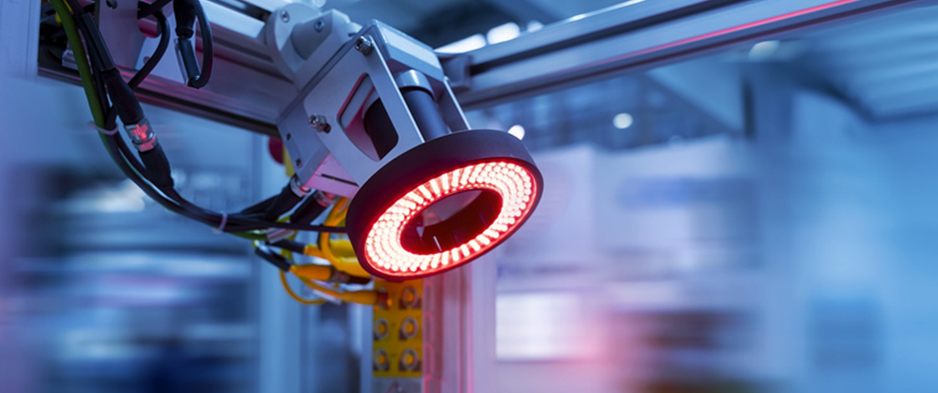
Robots today are no longer limited to following predefined instructions. Thanks to machine vision, they can interpret their surroundings and react accordingly. From warehouses to production lines, this technology is becoming a decisive driver of modern robotics, making processes faster, more accurate, and far more adaptable.
Machine Vision: What It Is and the Key Principles Behind It
Machine vision is the ability of a system to capture images or video and interpret them in a way that resembles human perception. It doesn’t simply record a scene, it analyses its content to recognize objects, estimate their position, evaluate shapes and dimensions, and even detect defects or anomalies.
At the core of these systems lies a combination of optical, electronic, and algorithmic components. A camera or sensor acquires the image, while software processes the data in real time. Today, deep learning algorithms are largely responsible for making machine vision significantly more reliable. Thanks to neural networks trained on massive datasets, these systems can identify minute defects, read codes under challenging conditions, detect overlapping or moving objects, and reconstruct three-dimensional scenes.
This capability is especially valuable in industrial environments, where machine vision enables increasingly stringent quality-control processes. Detecting micro-imperfections, identifying misalignments, or verifying component integrity has become fully automatable. Even more dynamic operations, such as product classification and sorting, can be carried out continuously and with high precision, dramatically reducing errors while boosting productivity.
Machine vision therefore provides machines not only with “eyes,” but also with a level of understanding that allows them to make operational decisions. It stands as a fundamental step toward smarter, more adaptive manufacturing.
Robotics and Machine Vision: Trends, Applications, and Future Outlook
In production facilities, robots equipped with machine vision no longer rely on rigid trajectories. They react to their environment in real time and can collaborate safely with human operators. They can recognize irregularly positioned components, orient them correctly, and perform tasks such as assembly, picking, or quality inspection. This reduces the need for dedicated fixtures and enables quick transitions from one product to another, without long re-engineering cycles.
The rise of cobots and autonomous devices has further broadened the range of applications. In warehouses, for example, machine vision allows mobile robots to navigate safely, avoid obstacles, adapt to variable material flows, and locate items even in cluttered environments. In agriculture, it enables the assessment of crop conditions, the identification of ripe produce, and the detection of pests or abnormalities. In healthcare, it supports the delicate manipulation of instruments or biological samples.
Recent developments are driven by multiple factors: more advanced sensors, increasingly affordable 3D cameras, greater processing power, and the growth of edge computing, which brings intelligence directly to the device. Robots of the future will be more autonomous and flexible, capable of operating in unstructured environments and collaborating seamlessly with human workers. Machine vision will allow them to understand complex scenarios, adapt to changing conditions, and make rapid decisions, becoming even more powerful tools for modern industries.